
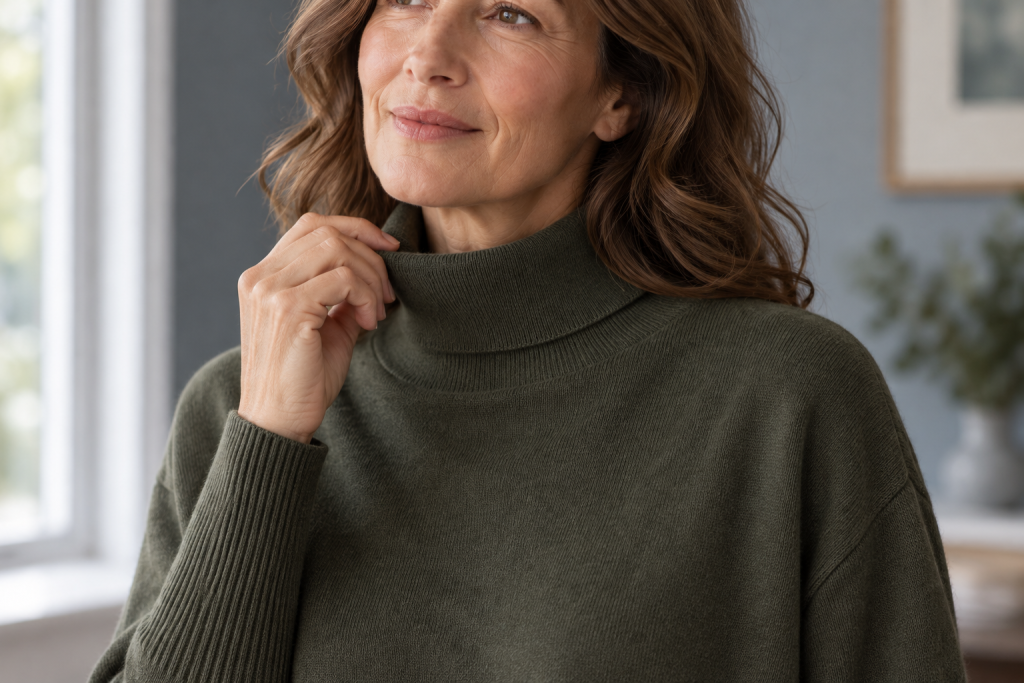
“Why is my wool jumper itchy?” is a fair question when a piece feels soft in your hands but uncomfortable around your neck. Fibre coarseness can contribute to prickle, yet the finished surface, the fit and where the garment touches you also matter.
You do not have to learn to tolerate a jumper you dislike wearing. A useful choice starts with identifying what bothers you: a hairy surface, a tight collar, a seam or simply too much fabric against the skin.
Quick answer: Coarser fibres can feel prickly because they bend less readily against the skin. A finer, smoother knit may feel more comfortable, but no fibre name guarantees that every garment will suit you. Check the inside of the neckline and sleeves, try your usual base layer and pay attention to your own response.
Why Is My Wool Jumper Itchy When It Feels Soft?
Your hand makes a brief assessment. A neckline stays in contact while you move, and cuffs may rub against the wrist for hours. A surface that feels pleasant when you stroke it can therefore feel quite different during wear.
Woolmark’s explanation of fibre softness identifies fibre diameter as an important factor: finer fibres bend more easily, while coarser fibres can create a prickling sensation. That does not make the word “wool” a verdict on comfort.
A fibre label also says little about a tight seam or the way a collar presses against you. Before ruling out a whole material, check whether it is the fabric itself or a particular part of the garment that feels wrong.
Look for the Source of the Discomfort
| Where you notice it | What to inspect | What to try |
|---|---|---|
| All over the fabric | The inner surface and any coarse or projecting fibres | A smoother knit or a fibre you already know you enjoy. |
| Only at the neck | Collar height, seam position and how firmly it touches the throat | A more open neckline, or a lower collar over a fine layer. |
| At wrists or underarms | Tight cuffs, seam bulk and local rubbing | A different sleeve shape with comfortable ease. |
| Only in a layered outfit | Whether a coat or shirt pushes the knit against the skin | Test the complete outfit, not the jumper alone. |
These are clothing checks, not a way to diagnose a skin condition. Take off a garment that causes irritation rather than continuing a try-on to see whether you get used to it.
Which Knitwear Feels Softer?
Fine wool and cashmere
A finer animal-fibre knit may be a good option if you like warmth but dislike a coarse surface. However, two garments with the same composition can feel different because of their yarn, construction and finish. Cashmere is not a universal promise of itch-free wear.
Our cashmere and merino comparison explores the different qualities to consider. Use it as a starting point, then judge the actual garment where it will touch your skin.
Cotton as an alternative
If you already know you prefer cotton, that preference is useful information. You do not need to buy a wool jumper simply because it is winter; an outer coat can provide additional warmth when needed.
The Lark Organic Cotton Jumper offers a different starting point. It is made from 100% organic cotton, with a wide rolled neckline and a relaxed shape. It is not a treatment for sensitive skin, but it is an option for someone who prefers wearing cotton.
For the practical trade-offs in different settings, read cotton versus wool jumpers. The right choice depends on where you spend your day as well as the weather outside.
Try the Jumper Where It Actually Touches You
- Check the inside. Feel the neckline, underarm seams and cuffs rather than stroking only the outside of the body.
- Wear your normal layer. If you always wear a cotton top underneath, take one with you. Check that its sleeves and neckline provide the coverage you want.
- Move naturally. Bend your elbows, sit down and turn your head. Notice if a collar rides up or a cuff catches.
- Compare rather than endure. Try a different neckline or surface alongside it. Stop if the garment starts to irritate you.
Softness is personal. A garment does not become the right purchase because someone else describes it as beautifully soft. If it bothers you during an ordinary try-on, choose a different piece.
Can a Base Layer Help With an Itchy Wool Jumper?
A smooth layer can reduce direct contact, especially beneath a textured jumper you enjoy wearing otherwise. Match its coverage to the problem. A vest will not protect your arms from the sleeves, and a low scoop neck will not separate your skin from a high collar.
Allow room for both garments. A tight base layer beneath a tight jumper can create a different sort of discomfort. Equally, avoid bunching a thick shirt inside a narrow sleeve.
This is a styling option, not an obligation to keep wearing a piece that causes irritation. Comfort should remain the deciding factor.
Will Washing Make Wool Less Itchy?
Do not buy an uncomfortable jumper on the assumption that washing will transform it. Washing is not a reliable way to change coarse fibres into fine ones. It may also affect the shape if the care method is wrong.
Follow the garment label and use an appropriate detergent. Avoid experimenting with hair conditioner or fabric softener as a guaranteed solution. Woolmark’s wool detergent advice explains why the washing product matters.
Questions Worth Asking Before You Order
- What is the full fibre composition?
- Does the inside look smooth or visibly textured?
- Where will the neckline sit against my skin?
- Is there room for the layer I usually wear underneath?
- Am I choosing a fabric I enjoy, or hoping I will get used to it?
If the photographs do not make the surface or fit clear, ask Ochre about the specific piece. A useful answer should describe the knit rather than promise that it will suit every person.
Frequently Asked Questions
Is all wool itchy?
No. Wool varies in fibre fineness and the finished knit varies in texture. Personal comfort also differs, so assess the actual garment rather than treating all wool as the same.
Does a hairy-looking jumper always feel scratchy?
No. A photograph shows surface texture, not how it will feel to you. Check the inside of the garment and the areas that make contact during wear.
Is expensive knitwear guaranteed to feel comfortable?
No. Price does not tell you whether a collar, seam, surface or fit will suit you. A comfortable try-on is more useful than assuming a higher price removes that uncertainty.
Should I keep wearing a jumper if it irritates my skin?
No. Remove it if it causes discomfort. If irritation persists or recurs beyond wearing that garment, seek advice from a healthcare professional rather than relying on clothing changes alone.
Choose a knit you enjoy against your skin, in the shape you will actually wear.
Explore organic cotton knitwear

