
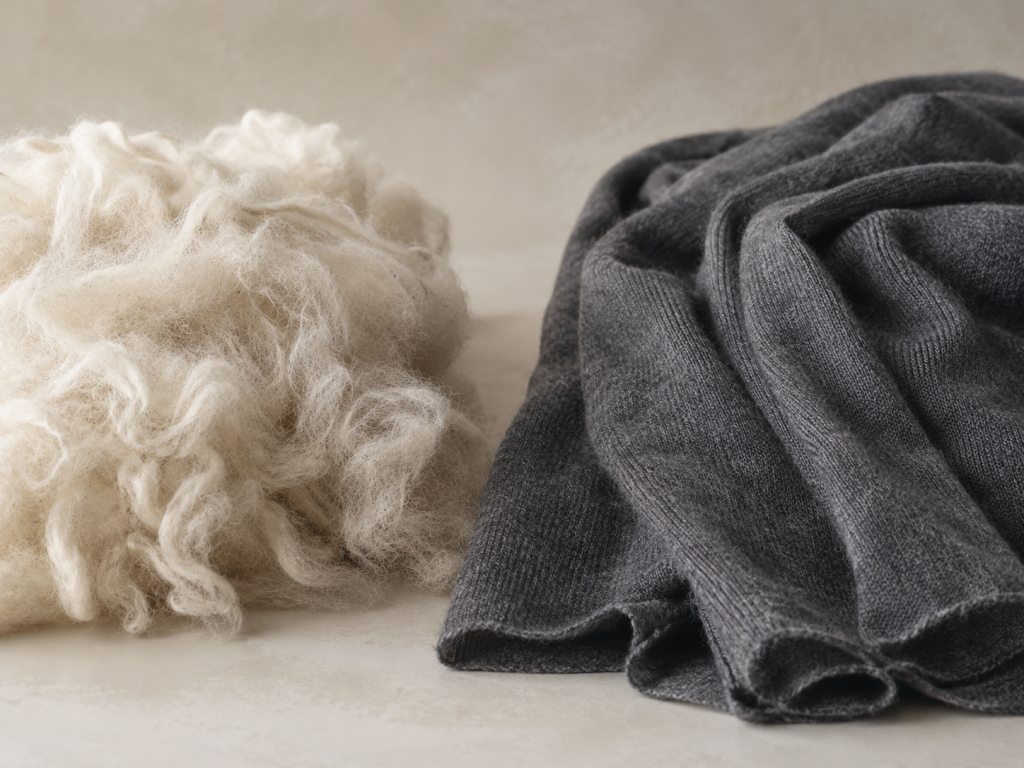
Grade A cashmere is a phrase often used to describe very fine, high-quality cashmere fibre. It sounds simple, but it is not a guarantee on its own. To understand what it really means, it helps to look beyond the label and ask what the fibre is like: how fine it is, how long it is, how cleanly it has been prepared, and how well it has been spun and knitted.
Cashmere is loved because it can feel warm, light and exceptionally soft. Yet two pieces labelled cashmere can feel very different. One may have a smooth, quiet handle and keep its shape for years. Another may feel soft at first, then quickly pill, stretch or lose its calm surface. The difference often begins at fibre level.
What Grade A cashmere usually refers to
Grade A cashmere usually refers to the finest category of cashmere fibre. In simple terms, it points to fibres that are very fine in diameter and long enough to spin into a smoother, stronger yarn. The finer the fibre, the softer it tends to feel against the skin. The longer the fibre, the better it can hold together during spinning and wear.
However, “Grade A” should not be treated as a magic phrase. It is most useful when it is supported by real fibre details such as micron count, staple length and the quality of sorting. That is why a thoughtful cashmere guide should look at measurable details, not just marketing language.
Micron count: why fineness matters
Micron count measures the diameter of the fibre. A lower micron count means a finer fibre, which usually gives cashmere its soft, gentle feel. Cashmere is already a fine undercoat fibre, but the best-feeling cashmere tends to sit at the finer end of the scale.
When cashmere feels harsh, prickly or unusually flat, the fibre may be coarser, less carefully sorted, or mixed with fibres that do not have the same softness. Ochre’s Ochre Cashmere Guide explains cashmere as a soft insulating undercoat known for warmth, lightness and a fine fibre diameter. That fine quality is central to why cashmere can feel luxurious without being heavy.
Staple length: the quiet detail behind lasting quality
Staple length means the average length of the fibre. This is one of the details many customers do not see, but it matters. Longer cashmere fibres can be spun into yarn with fewer loose ends. That can help the finished piece feel smoother and reduce the tendency for loose fibres to work their way to the surface.
This is why very cheap cashmere can sometimes feel soft in the beginning but become tired quickly. Ochre’s article Why Cheap Cashmere Feels Different explains that fibre length plays an important role in smoothness, strength and pilling. Good cashmere is not only about softness on day one; it is about how the fibre behaves after real wear.
Grade A cashmere still needs good yarn and construction
Even excellent fibre can be weakened by poor spinning, loose knitting or careless finishing. A beautiful raw fibre has to be turned into a yarn with balance, then knitted at the right tension for the garment. If the yarn is too loosely made or the knit structure is unstable, the finished piece may not perform as well as the fibre suggests.
This is where gauge and ply become useful. Ochre’s Cashmere Knit Gauge & Ply Guide explains that gauge affects the density of the knit, while ply refers to the number of yarn strands twisted together. Those choices affect weight, warmth, texture and structure. Good cashmere should therefore be judged as a complete piece: fibre, yarn, knit and finish together.
How Grade A cashmere should feel
Good cashmere should feel soft, but not weak. It should have a natural warmth without bulk, a calm surface and a gentle drape. It should not feel overly brushed, fragile or artificially fluffy. A very fluffy finish can feel impressive at first, but a more refined surface often wears more elegantly.
In larger pieces such as a shawl or wrap, the difference can be seen in the way the fabric falls. Ochre’s Cashmere Shawl is made from 100% cashmere and designed with generous proportions for light, soft coverage. A good cashmere shawl should fold easily, sit beautifully over the shoulders and feel warm without becoming heavy.
Pure cashmere, blends and honest descriptions
Grade A is most often discussed around pure cashmere fibre, but it is still important to read product descriptions carefully. A piece may be 100% cashmere, or it may be a cashmere blend designed for a different balance of softness, structure and everyday wear. Neither is automatically better for every person; the right choice depends on how the piece will be worn.
For example, the Cashmere Travel Wrap is a 100% cashmere piece made for softness, coverage and flexible layering. By contrast, a cashmere and lambswool blend can add more structure and bounce to jumpers or cardigans. Honest fibre descriptions help customers understand the difference.
What to look for before buying cashmere
When a product says Grade A cashmere, use it as the beginning of the conversation, not the end. Look for signs of fibre quality, but also consider the design. Does the knit have enough substance? Does the surface look calm? Are the edges and seams neat? Does the piece drape naturally? Does it feel like something that will be worn often, not only admired once?
Ochre’s About Us page explains that the brand selects cashmere yarn from Mongolia and makes knitwear and wraps in Kathmandu using hand-machine production and hand finishing. Those production choices matter because good cashmere is not only sourced; it is made carefully.
In the end, Grade A cashmere means very little if the finished piece does not feel beautiful, useful and lasting. The best cashmere has a quiet confidence. It feels soft without being flimsy, warm without being heavy, and special without needing to be saved for special occasions.
FAQ
What does Grade A cashmere mean?
Grade A cashmere usually refers to very fine, high-quality cashmere fibre with a soft handle and suitable fibre length. It is best understood through fibre details such as micron count, staple length and careful sorting.
Is Grade A cashmere always the best?
It is often used for the finest category of cashmere fibre, but the label alone is not enough. Yarn quality, knit structure, finishing and garment construction also affect how the finished piece feels and wears.
What is micron count in cashmere?
Micron count measures the diameter of the fibre. A lower micron count means a finer fibre, which usually gives cashmere a softer feel against the skin.
Why does fibre length matter in cashmere?
Longer cashmere fibres can be spun into smoother, stronger yarns with fewer loose ends. This can help reduce pilling and support better long-term wear.
Can 100% cashmere still vary in quality?
Yes. Two pieces can both be labelled 100% cashmere but feel different because of fibre fineness, fibre length, sorting, spinning, knit density and finishing.


