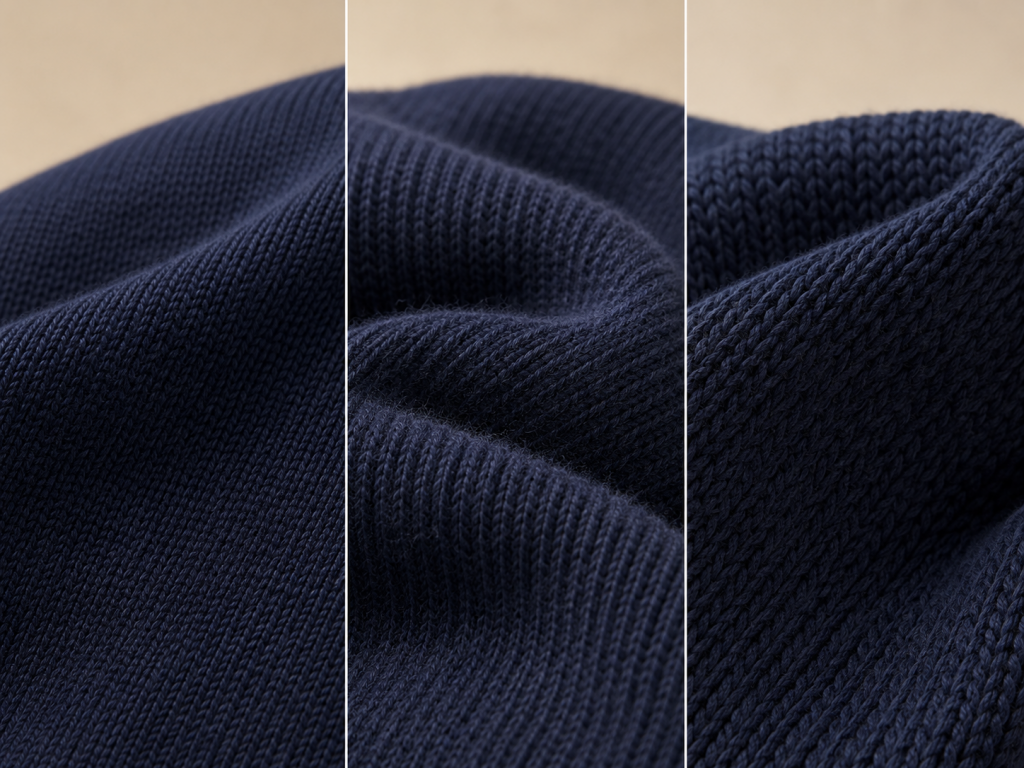
What does gauge mean in knitwear? It describes the needle density used to create the knitted fabric. In everyday terms, the number helps explain the scale of the stitches: higher gauges generally produce a finer surface, while lower gauges create larger, chunkier stitches.
That sounds straightforward, yet gauge is often mistaken for thickness, warmth or quality. It cannot promise any of those things by itself. Used alongside fibre, ply, stitch structure and garment measurements, however, it becomes a genuinely useful guide when you are buying knitwear online.
The short answer: gauge tells you how closely the needles are arranged on a knitting machine. A 12-gauge machine has more needles across an inch than a 4-gauge machine, so it can form smaller, finer stitches. The finished feel still depends on the yarn and the way it is knitted.
What Does Gauge Mean in Knitwear?
On a flat-knitting machine, gauge refers to the number of needles across one inch of the needle bed. The principle is simple: more needles within that space means finer spacing; fewer needles means wider spacing. Consequently, the gauge number gives the maker a framework for the scale and density of the knit.
It is worth separating machine gauge from the hand-knitting gauge you may see in a pattern. A hand-knitting pattern usually gives the number of stitches and rows in a measured swatch. A commercial product description normally refers to the machine gauge used to produce the fabric.
Even then, the finished cloth is not determined by the machine number alone. A maker can select different needles, alter stitch length, change tension, use a textured structure or combine yarns. Therefore, treat gauge as an important construction fact rather than an exact prediction of how every garment will feel.
Higher Gauge and Lower Gauge: The Easy Rule
Higher gauge
More closely spaced needles usually create smaller stitches and a smoother, finer-looking surface. These knits often work well as neat layers beneath jackets and coats.
Lower gauge
More widely spaced needles usually create larger stitches and a visibly chunkier texture. The fabric often has more presence and may need more room beneath outerwear.
The important limit
Higher does not mean better, and lower does not guarantee warmer. Gauge describes construction; the right choice depends on the garment’s purpose.
A useful memory aid is: the higher the number, the finer the potential stitch scale. Keep the word “potential” in mind. Thick yarn on a suitable construction can still create a substantial fabric, while fine yarn on a lower gauge may produce an open or airy result.
Three Real Examples: 4, 8 and 12 Gauge
The clearest way to understand gauge is to compare finished pieces rather than numbers in isolation. These Ochre examples use different fibres and ply constructions, so they also show why gauge is only one part of the answer.
| Construction | Real example | What you can expect | Useful for |
|---|---|---|---|
| 4 gauge / 6 ply | Rue Chunky Yak Crew Neck Jumper | Large stitches, tactile texture and a substantial winter character in yak wool. | Cold days, visible texture and a jumper worn as a main layer. |
| 8 gauge / 2 ply | Cashmere Travel Wrap | A mid-gauge cashmere construction that remains soft, flexible and easy to drape. | Adaptable warmth, travel and layering without a rigid shape. |
| 12 gauge / 2 ply | Lark Organic Cotton Jumper | A finer organic-cotton rib with a smoother scale, relaxed shape and breathable handle. | Transitional weather and lighter layering. |
Notice that the 8-gauge wrap is not simply halfway between the other two in warmth or weight. It uses pure cashmere, has a different shape and is designed to drape around the body. Meanwhile, Lark’s fine rib and Rue’s chunky yak construction serve completely different wardrobe needs. The label describes how each fabric was built; the full design explains how it wears.
Gauge Is Not the Same as Ply
Gauge and ply are often written together because each supplies a different clue. Gauge concerns needle spacing and stitch scale. Ply, in an Ochre product description, indicates how many yarn strands are combined in the yarn construction.
A higher ply can add fullness, strength or substance, but it is not a universal warmth rating. The strands may be very fine, the fibre may be light, and the stitch structure may hold more or less air. Equally, two-ply yarn can be used in both an 8-gauge cashmere wrap and a 12-gauge cotton jumper, yet the finished pieces will not behave alike.
Read the pair, not one number: “4 gauge / 6 ply” suggests a very different construction from “12 gauge / 2 ply”. Then read the fibre content, silhouette and measurements to understand the garment rather than trying to rank it.
Does Gauge Tell You How Warm Knitwear Will Be?
Not reliably on its own. Lower-gauge knitwear is often chunky, and chunky fabric can trap insulating air. Still, warmth also comes from the fibre, the amount and loft of the yarn, stitch structure, garment coverage and the layers worn above and below it.
A dense fine-gauge wool layer can feel very warm beneath a coat because it sits close to the body and does not leave bulky gaps. An open chunky stitch may feel generous and tactile but allow more air to pass through. Cashmere, yak, merino and cotton also manage heat and moisture differently.
When warmth is the priority, use gauge to understand stitch scale, then look for the fibre, weight, neckline, sleeve length and fit. A longline cardigan, fitted crew neck and loose boat-neck jumper can all use similar yarn yet provide different levels of coverage.
Why Two Knits with the Same Gauge Feel Different
Imagine two 8-gauge pieces. One uses a smooth, tightly spun yarn in a compact jersey stitch. The other uses a loftier yarn with a soft halo and a more relaxed tension. Although the machine gauge is the same, the surface, drape and perceived thickness may be noticeably different.
Five details change the result:
- Fibre: cashmere, yak, merino, mohair, cotton and linen each have a different handle and natural behaviour.
- Yarn size and ply: the thickness and construction of the yarn affect fullness and weight.
- Stitch structure: rib, jersey, cable, tuck stitches and open textures use yarn and hold air differently.
- Tension: tighter or more relaxed knitting changes density, stretch and drape.
- Finishing: washing, steaming and brushing can alter softness, bloom and final dimensions.
This is why online descriptions are most helpful when they state more than fibre content. Gauge, ply, fit notes and flat garment measurements let you build a much more accurate picture before ordering.
How Gauge Changes Drape, Shape and Layering
Fine-gauge fabric often falls closer to the body and creates a cleaner outline. It can tuck more easily, sit beneath tailoring and form refined ribbed edges without much bulk. Depending on the fibre and cut, it may feel fluid or softly structured.
Chunkier fabric has greater visual depth. Larger stitches make the knitting itself part of the design, while the extra volume can support generous collars, deep ribbing or an oversized silhouette. That presence is attractive, although it also occupies more space beneath a fitted coat.
Neither construction dictates fit. A 12-gauge jumper can be relaxed and wide, while a lower-gauge style can be carefully shaped. Always check the garment measurements. Gauge tells you about the fabric; measurements tell you how much room, length and coverage the finished piece provides.
Is Fine Gauge More Delicate?
Fine stitches can be more vulnerable to snagging on jewellery, rough bags or sharp fastenings, especially when the yarn itself is very fine. However, a fine gauge is not automatically fragile. Balanced tension, good yarn and secure finishing can produce a smooth, resilient garment.
Chunky knitwear has its own considerations. Larger loops can catch, and a heavy body may stretch if it is stored on a hanger. Friction may also affect raised surfaces more quickly. Care should follow the construction rather than the assumption that thicker always means tougher.
If longevity matters, combine the gauge information with a close look at seams, ribbing, surface consistency and care instructions. Our guide to how to tell if knitwear will last gives a practical two-minute inspection for those details.
How to Choose the Right Gauge for Your Wardrobe
Start with the job the garment needs to do. For a layer beneath a blazer, a finer construction is often comfortable and visually neat. For a jumper that carries an outfit on a cold day, a low-gauge fabric can add texture and substance. For travel, consider whether you value packability, adaptable drape or maximum warmth.
- Choose the occasion: indoor layer, outdoor warmth, travel wrap or statement texture.
- Check the fibre: it will strongly influence warmth, breathability, softness and recovery.
- Read gauge and ply together: use them to anticipate stitch scale and substance.
- Study the product photographs: look at stitch size, surface texture, ribbing and how the fabric hangs.
- Compare measurements: width, length and sleeve construction reveal fit more accurately than gauge.
- Consider your outerwear: make sure the knit has enough room beneath the coats or jackets you wear.
- Check care and storage: choose a construction you can look after confidently.
A number should narrow your expectations, not make the final decision. The most successful choice is the garment whose construction, fibre and shape all suit your climate, wardrobe and preferred way of dressing.
Frequently Asked Questions About Knitwear Gauge
What does gauge mean in knitwear?
Gauge is the number used to describe needle density on a knitting machine. In general, a higher gauge produces smaller, finer stitches, while a lower gauge produces larger, chunkier stitches. It is a construction clue, not a quality score.
Is a higher gauge knit thinner?
Usually, but not always. A higher-gauge fabric often looks finer and sits more neatly under other layers. Yarn thickness, ply, stitch structure and finishing can still make two garments with the same gauge feel very different.
Is 12-gauge knitwear warmer than 4-gauge knitwear?
The number alone cannot answer that. Twelve gauge usually gives a finer surface, while four gauge usually creates larger stitches and a chunkier fabric. Warmth also depends on the fibre, amount of yarn, ply, knit structure and how much air the fabric traps.
What is the difference between gauge and ply?
Gauge relates to needle density and the scale of the stitches. Ply describes how many yarn strands are combined in the yarn construction. Read together, they give a better indication of weight and texture than either number on its own.
Does low-gauge knitwear last longer?
Not automatically. Chunky knitwear may feel substantial, but durability depends on yarn quality, balanced tension, secure construction, fit, friction and care. A well-made fine-gauge jumper can outlast a poorly balanced heavy one.
Which knitwear gauge is best for year-round wear?
A fine or medium construction is often the most versatile for layering, but fibre and climate matter as much as gauge. Choose the finished garment for the temperature, outfit and level of warmth you need rather than relying on one number.
Use gauge as a practical clue, then choose the fibre, weight and shape that will earn a real place in your wardrobe.
Explore Ochre jumpers

