
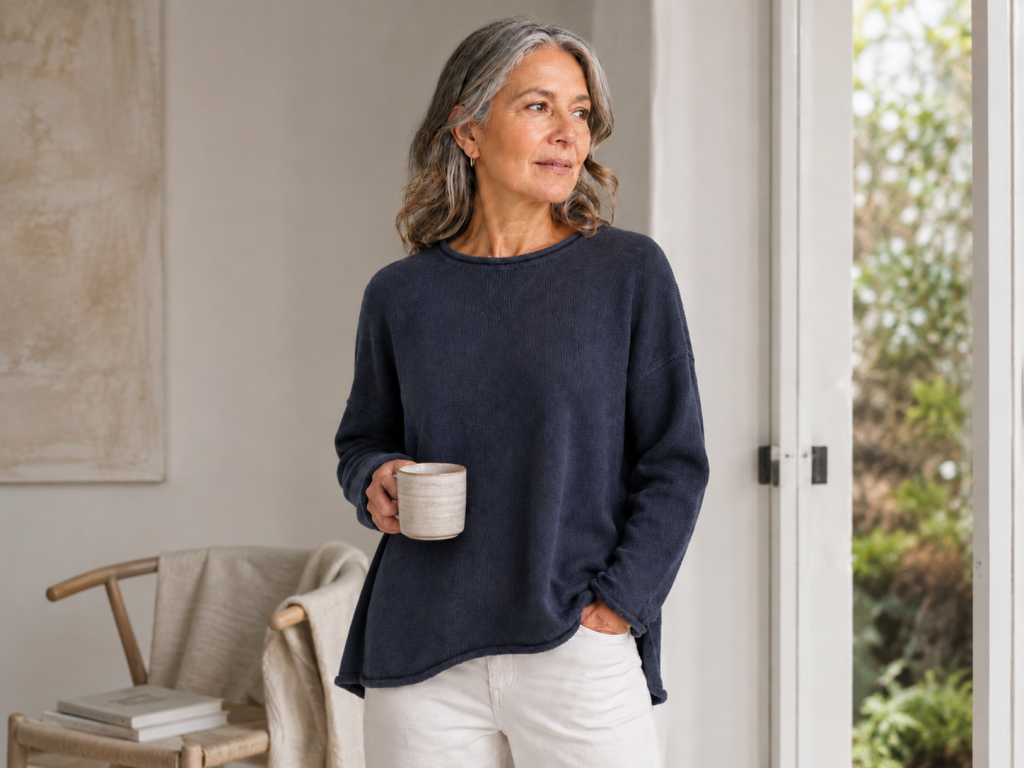
Organic cotton knitwear is often placed in the summer part of the wardrobe, as if it belongs only to the brightest months of the year. In reality, it is one of the most useful fibres for the in-between moments most of us dress for more often: cool mornings, mild afternoons, windy coast days, early autumn weekends and spring days that never quite settle. When the weight is right and the shape is well judged, organic cotton feels breathable, soft and quietly substantial rather than flimsy or overly warm.
That is exactly why Ochre’s organic cotton collection feels so relevant beyond summer. These are not throwaway warm-weather knits. They are thoughtfully made layers with shape, texture and ease — pieces that help a wardrobe move gently from one season to the next.
Why organic cotton works beyond hot weather
The appeal of organic cotton is not simply that it feels lighter than wool. It is that it sits in a useful middle ground. It breathes well, so it does not trap heat in the way synthetic fibres often do, yet it still offers enough coverage to feel comforting when the air turns cooler. That balance matters more than people sometimes realise.
On very hot days, a cotton knit may feel unnecessary. However, most days are not truly hot from morning until night. Many begin cool, shift warmer by midday and turn fresh again in the evening. Organic cotton handles those changes beautifully. It gives the body softness and coverage without the heavy feeling that can make dressing feel cumbersome.
There is also a visual reason it works so well outside summer. Good organic cotton knitwear has definition. It can hold a neckline cleanly, let a sleeve fall well and keep a hemline neat. That structure helps an outfit look composed even when the overall mood is relaxed.
Shape matters as much as fibre
The reason some cotton pieces earn a place far beyond one season usually comes down to design. Ochre’s Jonah Organic Cotton Jumper is a strong example. Its wide rolled neckline, dropped shoulders and curved hem give it a modern line, while the midweight organic cotton keeps the shape soft rather than stiff. It is the sort of piece that feels calm on its own, yet still layers well when the day cools down.
For a slightly different mood, the Shyla Cotton Jumper shows how refined organic cotton can look. The raglan sleeves, rolled neckline and curved rolled hem create a lighter, more polished feel. It is easy to imagine it worn on a bright spring morning, but it makes just as much sense later in the year under a coat or with a scarf once the weather turns.
Then there is the Lark Organic Cotton Jumper, whose fine rib texture gives the piece a slightly more defined character. The wide rounded neckline, dropped shoulder and rolled edges keep it relaxed, while the rib brings a little depth and tactility. That kind of texture is especially useful when dressing through cooler months, because it adds interest without needing heavy styling.
Organic cotton layers without the bulk
One of the best arguments for wearing organic cotton outside summer is how well it layers. A wool jumper can sometimes feel too insulating indoors. A jersey top can feel too slight once the temperature dips. Organic cotton often bridges that gap. It sits comfortably over a simple base layer, works neatly beneath outerwear and still feels balanced if worn alone indoors.
This makes it ideal for everyday life rather than just a single weather type. School runs, long drives, train journeys, coastal walks, city errands and early dinners all tend to involve changing temperatures. A breathable cotton knit helps you stay comfortable without constantly adjusting what you are wearing. There is a quiet practicality in that, but there is elegance too. The best layers do not just solve a problem; they make dressing feel simpler.
It suits a slower, more considered wardrobe
There is another reason organic cotton belongs well beyond summer: it fits naturally into a wardrobe built on repetition rather than novelty. A beautifully cut cotton knit can be worn across spring, summer evenings, early autumn and mild winter indoor days. Instead of sitting untouched for half the year, it remains part of regular life.
That rhythm feels especially in tune with Ochre’s approach to natural fibres and thoughtful making. On the brand’s sustainability page, Ochre explains its focus on ethically sourced yarns, including GOTS-certified organic cotton, and a production process shaped by care, durability and environmental responsibility. That matters because a useful garment should not only feel good for one season; it should continue to earn its place over time.
How to wear organic cotton once summer ends
The easiest way is to stop thinking of organic cotton as only a warm-weather fabric and start thinking about it as a trans-seasonal layer. On soft autumn days, it can replace a heavier jumper. In spring, it can be the piece that carries an outfit from chilly breakfast to sunnier afternoon. On travel days, it gives warmth without the heaviness that can make a journey feel uncomfortable. Indoors, it keeps its ease because it does not overheat the body in the way dense winter knitwear sometimes can.
Perhaps that is the real point. Organic cotton is not just for summer because most good wardrobes are not built around one season at a time. They are built around useful, wearable pieces that move through real life. When the cut is generous, the finish is considered and the fibre is good, an organic cotton knit becomes far more than a summer extra. It becomes one of the most quietly dependable pieces you own.
FAQ
Is organic cotton knitwear warm enough for cooler days?
Yes, especially when the knit has some substance. Organic cotton does not insulate like heavy wool, but it provides gentle warmth and good breathability, which makes it ideal for mild to cool days and changing weather.
Why does organic cotton work so well between seasons?
Because it sits between extremes. It is lighter and more breathable than winter wool, yet more substantial than a simple jersey layer. That makes it particularly useful in spring, early autumn and cooler summer evenings.
Which Ochre organic cotton styles feel most trans-seasonal?
Jonah, Shyla and Lark are all strong examples. Jonah offers a relaxed architectural shape, Shyla feels polished and softly refined, and Lark brings fine rib texture with an easy fit that layers well.
Does organic cotton only suit casual outfits?
No. The fibre itself is versatile, and the result depends on the cut and finish of the garment. A clean neckline, thoughtful sleeve line and well-balanced hem can make organic cotton look calm, elevated and very polished.
Is organic cotton a good choice if I do not want bulky layers?
Absolutely. That is one of its biggest strengths. It offers softness and coverage without the weight or heaviness that can make colder-weather dressing feel bulky.


