
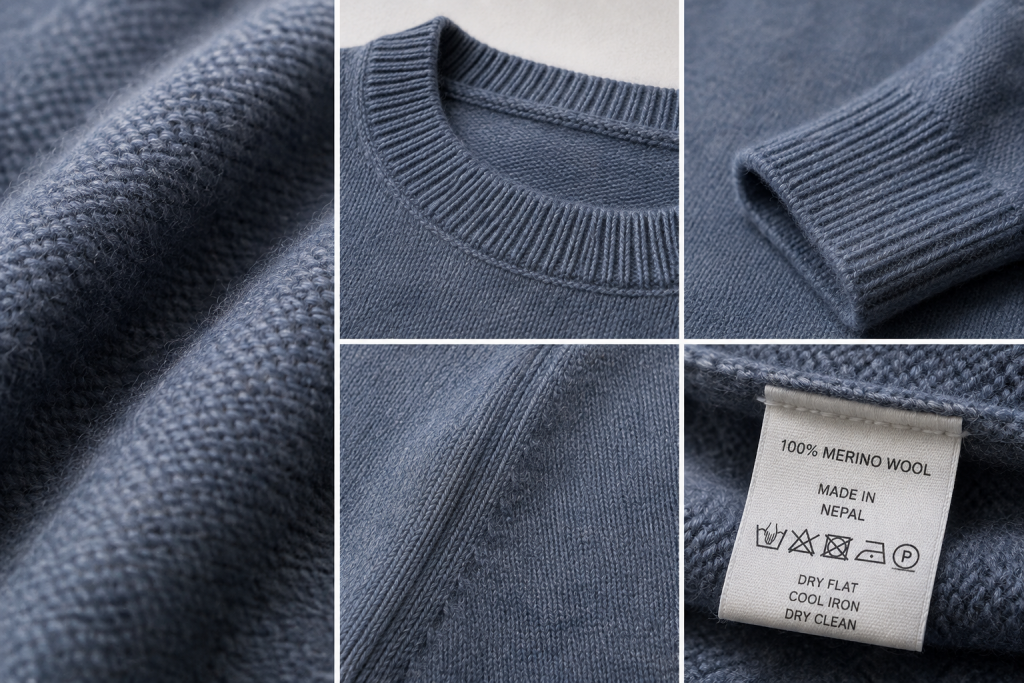
How to tell if knitwear will last begins with looking beyond softness and price. Check whether the fabric feels balanced, the stitches are even, the seams lie securely and the neckline, cuffs and hem recover after gentle movement. Then consider whether the fibre, weight and care requirements suit the way you will actually wear the garment.
No single test can guarantee a jumper’s lifespan. However, a careful two-minute inspection can reveal far more than a luxury label or a thick, fluffy first impression. Lasting knitwear is usually the result of several modest details working together.
The quickest quality check: gently compress a ribbed cuff and see whether it returns neatly; inspect the seams for loose loops or strain; check the knit against the light for unexpected thin patches; and make sure the neckline sits flat without twisting. Finally, read the composition and care label before deciding.
How to Tell If Knitwear Will Last in Two Minutes
1. Look at the surface
The stitches should appear consistent for the intended texture. A deliberate slub, cable or brushed halo is different from random weak patches, pulled loops or broken yarn.
2. Test the recovery
Gently squeeze or stretch a small ribbed area, without pulling the garment out of shape. It should settle back rather than remaining loose or wavy.
3. Inspect the joins
Turn the garment carefully and examine the shoulder, underarm and side seams. Look for secure, even joining without gaps, trapped loose ends or puckering.
4. Check the edges
The neckline, cuffs and hem should look intentional and balanced. These hard-working areas often show whether the construction can cope with repeated wear.
5. Read the label
Confirm the fibre composition and care instructions. A garment is only a sensible investment when you are comfortable with how it needs to be washed and stored.
6. Judge the whole shape
Hang or lay the piece naturally. The body should not twist, one sleeve should not pull differently from the other, and the hem should sit as designed.
Softness Is Not the Same as Quality
Softness is appealing, but it is an unreliable test on its own. Some fine natural fibres are genuinely soft, while intensive finishing can make a weaker yarn feel unusually fluffy in the shop. That first-touch softness may hide a loose surface that is more prone to friction and pilling.
Equally, excellent cashmere or wool does not need to feel harsh, and a smooth organic-cotton knit does not need a fuzzy halo to be well made. The better question is whether the handle suits the fibre and construction. A lofty wrap, a fine merino crew neck and a dense yak jumper should not all feel identical.
Use touch as one part of the decision. Combine it with recovery, stitch consistency, seams and the intended use of the garment. Quality is a system, not a single sensation.
Check Knit Density—But Do Not Mistake Fine for Flimsy
Hold the garment up in ordinary light and look across the fabric. You are checking for consistency, not trying to prove that no light passes through. A fine-gauge jumper is naturally more delicate and may appear lighter than a chunky knit. That does not make it poorly constructed.
What matters is whether the density is even. Unexpected transparent patches, laddering, distorted stitches or areas that look much looser than the rest deserve closer attention. On a textured garment, follow the pattern and check that it continues cleanly across the body.
Gauge describes stitch density, while ply describes how yarn strands are constructed. Neither number is a simple quality score. Ochre’s guide to what gauge means in knitwear explains why a fine layer and a chunky winter jumper should be assessed differently.
Recovery Reveals How the Garment May Age
Knitwear must move with the body, so some stretch is essential. Recovery is its ability to return towards the intended shape afterwards. Ribbed cuffs, hems and necklines make this easiest to judge because they are designed to expand and contract.
Press a cuff gently between your fingers or widen a very small section without force. The ribs should remain defined and return calmly. A loose cuff is not always a defect—some designs deliberately use a soft open edge—but it should look like a design choice rather than exhausted elastic tension.
Natural fibres behave differently. Merino has useful spring, cashmere brings softness and loft, cotton has less natural elasticity, and a chunky yak construction carries more weight. The maker must balance the yarn, stitch and finishing so the shape works with the fibre rather than against it.
Examine the Seams, Shoulders and Underarms
Seams carry movement and weight. Look first at the underarms and shoulders, where a garment experiences repeated strain. The joins should feel secure, and the stitches beside them should not appear stretched open. Loose loops, missed stitches and ends escaping from a seam can become problems after wear.
Do not assume that one construction method is always superior. Fully fashioned shaping, linked seams and neatly finished overlocked joins can all be appropriate when used well. The practical test is whether the seam lies comfortably, follows the intended line and has enough strength without becoming bulky.
Check symmetry too. Raglan lines should travel evenly from neckline to underarm. Set-in shoulders should sit consistently on both sides, while dropped shoulders should fall at the same level. A twisted sleeve or spiralling side seam may suggest that the garment will never settle properly.
The Neckline, Cuffs and Hem Work Hardest
These edges are repeatedly pulled, touched and rubbed. A crew neck must pass over the head, cuffs move across hands and sleeves, and a hem encounters waistbands, chairs and coats. Their construction often predicts how composed the whole garment will look after regular wear.
Inspect the neckline for rippling, twisting or tension where the trim joins the body. Check whether the cuff ribbing is even and whether the hem lies at the intended level. Rolled edges and raw-looking finishes can be deliberate, but they should repeat consistently rather than appearing unfinished in one area.
The Scott Crew Neck Jumper provides a useful fine-knit example. Its 100% merino construction uses a classic crew neck and refined ribbed trims, so the quality assessment should focus on smooth stitch consistency, clean joining and resilient edges rather than chunky weight.
Does Thicker Knitwear Last Longer?
No. Thickness can offer warmth and a substantial feel, but it does not automatically create durability. A heavy jumper with loose tension may distort under its own weight, while a well-balanced fine knit can retain its shape for years.
The Rue Chunky Yak Crew Neck Jumper demonstrates a different construction from Scott. Its 4-gauge, 6-ply yak knit is intentionally tactile and substantial. Here, look for consistent chunky stitches, secure seams and ribbing strong enough to balance the weight of the body and sleeves.
Weight must make sense for the design. A longer or oversized garment needs enough structural control to prevent the shoulders and hem from becoming overwhelmed. Conversely, a lightweight layer should not be judged negatively simply because it folds into a small space.
Fibre Content Matters, but It Is Not the Whole Answer
Natural fibres bring valuable qualities, yet the composition label cannot describe yarn grade, fibre length, spinning, twist, knit density or finishing. Two garments marked 100% wool can behave very differently. The same is true of cashmere, yak, merino, cotton and linen.
Blends are not automatically inferior either. A considered blend may combine warmth, softness, structure or texture for a particular purpose. What matters is whether the composition is clearly stated and whether the finished garment behaves as promised.
Ask what role the piece needs to fulfil. A breathable cotton layer, a soft cashmere wrap and a resilient merino jumper solve different problems. Longevity begins when the material suits both the design and your real pattern of wear.
Does Pilling Mean Knitwear Is Poor Quality?
Not necessarily. Pilling occurs when loose fibres migrate to the surface and friction rolls them into small balls. It is especially common where sleeves rub against the body, a handbag touches the hip or a jumper sits beneath a coat.
Fibre length, yarn twist, fabric density, finishing and the wearer’s activity all influence pilling. Therefore, “will never pill” is not a realistic promise for every natural-fibre garment. Excessive early pilling across low-friction areas may be concerning, but a small amount of localised pilling can be normal and manageable.
A useful distinction: a soft halo belongs to the surface of the yarn; pills are small tangled balls created through friction. Do not remove a natural halo simply because it is visible. If pills form, use the care method recommended for that specific garment and work gently.
Fit Also Determines How Long Knitwear Lasts
A garment under constant strain will experience more stress at seams, elbows, underarms and button bands. One that is much too large may rub, catch and carry excess weight in places the design did not anticipate. Correct fit is therefore part of durability, not only appearance.
Compare the product measurements with a similar piece you already wear. Pay attention to chest width, body length, sleeve construction and the layers intended underneath. The Ochre guide to measuring a jumper before buying online explains how to make that comparison accurately.
Movement should feel comfortable without strong pulling. A relaxed shape can have generous ease, but the neckline should still sit calmly and the seams should not be dragged out of line.
Read the Care Label Before You Buy
The best-made garment will not suit your wardrobe if its care requirements are impractical for you. Check whether it needs hand washing, a wool cycle or professional cleaning. Look for instructions about temperature, drying and ironing rather than assuming all natural fibres can be treated alike.
When the label permits washing, support wet knitwear carefully and reshape it rather than wringing. Flat drying is often the safest approach because the weight of water can stretch a garment on a hanger. For storage, clean knitwear should generally be folded so the shoulders and body are not pulled out of shape.
Clear care instructions are a positive sign because they help the customer protect the intended finish. Vague guidance does not prove poor construction, but it leaves more room for avoidable damage.
Your Knitwear Quality Checklist
| Area | Encouraging sign | Reason to look closer |
|---|---|---|
| Knit surface | Consistent stitches or a clearly intentional texture | Random thin patches, pulled loops or broken yarn |
| Recovery | Ribbing settles after gentle movement | Edges remain stretched, rippled or uneven |
| Seams | Secure, even joins that lie comfortably | Gaps, loose ends, puckering or strained stitches |
| Shape | Balanced shoulders, sleeves and hem | Twisting, spiralling or unexplained asymmetry |
| Composition | Clear fibre percentages and an appropriate handle | Unclear labelling or claims unsupported by the label |
| Care | Specific instructions you can realistically follow | No usable guidance for washing, drying or storage |
Price Is Not Proof of Longevity
A higher price can reflect better fibres, smaller production, skilled construction or thoughtful design. It can also reflect branding, marketing and retail costs. Price alone cannot tell you whether a jumper will keep its shape.
The sharper question is cost per wear. Will the garment fit comfortably, work with clothes you already own and receive the care it needs? A beautifully made piece that remains unworn is not good value, while a considered jumper worn weekly can justify a higher initial cost.
- Check the composition and care label.
- Inspect stitch consistency in ordinary light.
- Test the recovery of one ribbed edge gently.
- Look at shoulders, underarms and side seams.
- Confirm that the neckline and hem sit evenly.
- Compare measurements with a garment you already trust.
- Decide whether the weight and fibre suit its intended use.
- Ask yourself how often you can genuinely wear it.
Frequently Asked Questions About Lasting Knitwear
What is the easiest way to spot long-lasting knitwear?
Start with the hard-working areas: seams, neckline, cuffs and hem. They should look even, secure and appropriate to the design. Then check that the ribbing recovers after gentle movement and that the fabric has no unexplained weak patches.
Does expensive knitwear always last longer?
No. Price may reflect fibre quality, construction and skilled production, but it may also include branding and other costs. Inspect the garment itself and consider fit, care requirements and likely cost per wear.
Does thicker knitwear last longer?
Not automatically. A heavy but loosely balanced knit may stretch, while a well-made fine knit can retain its shape. Yarn, tension, seams, ribbing and care matter more than thickness alone.
Is pilling a sign of poor-quality knitwear?
Not by itself. Friction can cause both good and poor-quality natural-fibre garments to pill. Heavy early pilling in low-friction areas deserves attention, but small localised pills can be normal and carefully removable.
How should I store knitwear so it keeps its shape?
Follow the garment’s care instructions and store it clean, dry and folded. Long-term hanging can pull at the shoulders and length. Avoid damp storage and check garments periodically for moth activity.
Which part of a jumper usually wears out first?
Cuffs, underarms, elbows, side seams and hems often receive the most friction and movement. Their condition depends on the design and how the garment is worn, so inspect these areas closely before buying and during care.
Look beyond the first touch and choose knitwear whose fibre, construction and fit make sense for the way you live.
Explore Ochre jumpers

