
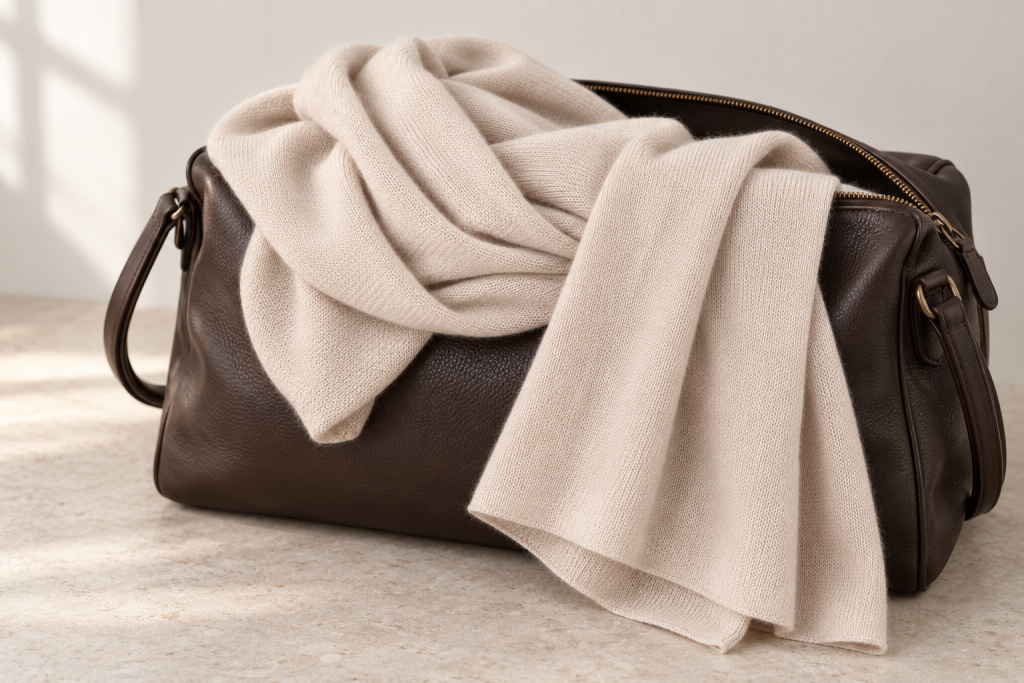
To choose a cashmere travel wrap, start with the area you want it to cover, then consider warmth and the space left in your bag. A wrap that looks generous in a photograph may feel quite different around your shoulders. Equally, the smallest piece to pack may not give you the coverage you want on a long journey.
The aim is to find a layer you will reach for on the way there, while you are away and after you come home. Here is how to judge the details before buying.
What makes a cashmere travel wrap useful?
A travel wrap is a broad piece of fabric that you can open across your shoulders or lap, then fold into a scarf. Unlike a fitted garment, it lets you change the coverage without taking a layer on and off over your head. That can be helpful when moving between a warm station, a cool carriage and the outdoors.
Its usefulness depends on your habits. If you only want neck warmth beneath a coat, a narrower scarf may be easier to carry. Choose a wrap when you also want a layer across your upper body or something to put over an evening outfit.
Choose the size of your cashmere travel wrap first
Length and width do different jobs. The length determines how far the ends fall and how much fabric you have to bring around your body. The width determines the depth of coverage across your back, shoulders or lap.
For a concrete example, Ochre’s Cashmere Travel Wrap measures approximately 200 × 90 cm. It is a rectangle knitted in 100% cashmere, with an 8-gauge, 2-ply construction. Measurements may vary slightly.
At that size, folding the width in half gives a strip about 45 cm deep before any further folds. Opening it again restores the full 90 cm width. That flexibility is useful, but it also means carrying more fabric than you would with a narrow scarf.
Try a simple coverage check at home
- Lay out a sheet or a large piece of fabric and mark the wrap’s stated length and width with a tape measure.
- Fold it to those dimensions, then place it around your shoulders while wearing the layers you expect to travel in.
- Sit down and bring one end across your front. Check whether your arms and back have the coverage you want.
- Stand up and check the length of the ends. Notice whether you would keep adjusting them while walking.
This shows the approximate coverage only. A sheet will not reproduce the stretch, warmth, thickness or drape of cashmere. However, it is a useful way to understand dimensions that can be hard to picture on a screen.
How much warmth do you need?
Think about where you will use the wrap most. A layer for a cool restaurant has a different job from one you hope to wear outside on a windy winter day.
Fibre content is only part of the answer. Fabric thickness, stitch structure, coverage and the clothes underneath all affect how warm a wrap feels. More ply does not, by itself, establish a warmer or better-quality product. Our cashmere weight guide explains how to read those construction clues together.
| Main use | Prioritise | Check before buying |
|---|---|---|
| Flights and train journeys | Coverage when seated and easy access in your bag. | Can you cover your shoulders or lap without constantly rearranging it? |
| Evenings away | A drape that works over your planned outfit. | Will the wrap sit comfortably over the sleeves and neckline? |
| Cold-weather travel | A useful extra layer alongside suitable outerwear. | Does it fit comfortably with your coat and other layers? |
| A small day bag | Manageable folded volume. | Would a narrower scarf meet your needs with less fabric? |
A knitted wrap can add comfort, but it should not be your only protection from cold, wind or rain. Keep weather-appropriate outerwear in your plans, especially if you will spend long periods outside.
Packability: look beyond the word “lightweight”
Weight and packed size are separate questions. Grams tell you how heavy an item is; folded dimensions tell you how much room it occupies. A broad, fine wrap can still take up a useful part of a small bag simply because there is a lot of fabric.
If luggage space is tight, ask for the finished weight and a loosely folded measurement. Neither can be calculated reliably from gauge and ply alone. Also check what the retailer means by “compact”: a wrap pressed firmly for a photograph may take up more space when packed loosely.
Use the bag you will actually carry
Pack your usual essentials first. Then work out where the wrap would go and whether you could reach it without unpacking everything. A generous shoulder layer is less convenient if it ends up at the bottom of your luggage throughout the journey.
If space matters more than shoulder coverage, compare the shapes in our knitted accessories collection. Buying a smaller piece that suits your routine can be a better choice than squeezing in a wrap you rarely unfold.
Check the fabric and finish as well as the label
Read the fibre composition in full. “Cashmere blend” and “100% cashmere” describe different compositions, so compare what is actually listed rather than relying on a product name.
Next, look for close photographs of the stitches, surface and edges. Check whether the fabric hangs softly or holds a firmer shape. A draped photograph helps you judge movement; a close-up helps you see the construction. Neither proves how a piece will feel against your skin, so ask about the handle if that matters to you.
Consider the finish in use, too. Decorative edges can be attractive, but a plain edge may be easier to keep clear of bag fastenings. The right choice is the one that works with how you carry and wear your clothes.
Plan for more than the journey
Before deciding, name two occasions when you would use the wrap at your destination. Perhaps it will sit over a dress at dinner and across your shoulders while reading. If both feel realistic, the space in your bag is easier to justify.
Try the same question at home. Would you keep it near your desk, wear it on an evening out or use it for shorter train trips? A travel accessory earns its place more easily when it also fits ordinary days. For outfit combinations, see our cashmere travel wrap styling guide.
How to pack and care for it on a trip
- Fold the wrap neatly and keep it away from exposed zips, hook-and-loop fastenings and sharp jewellery.
- If your bag has rough compartments, use a clean fabric pouch to separate the knit from them.
- Let the wrap air when you arrive, and put it away dry.
- Check the care label before washing. Allow enough time and space for the piece to dry fully before travelling again.
Ochre’s wrap is suitable for hand washing or dry cleaning as directed by its care label. For a short trip, planning how you will protect and air it may be more useful than expecting to wash it while you are away.
Five questions to ask before ordering
- Do the stated dimensions give me the coverage I want?
- Will this be an extra layer, or am I expecting it to do the job of a coat?
- Do I have room for it alongside my usual bag contents?
- Can I picture wearing it after the trip?
- Have I checked availability and the delivery estimate for my departure date?
If any detail is unclear, ask the Ochre team before you travel. Mention when you leave and what you need the wrap to do, so the advice can be specific.
Cashmere travel wrap questions
What is a good size for a cashmere travel wrap?
There is no single ideal size. Compare both length and width with the coverage you want when seated and standing. Ochre’s wrap measures approximately 200 × 90 cm; use those dimensions for a simple coverage check before choosing.
Is a cashmere travel wrap warm enough for a flight?
It can be a useful extra layer, but comfort depends on cabin conditions, the wrap’s construction, your clothing and how easily you feel cold. Choose enough coverage and bring another layer if you usually need one.
Does 2-ply cashmere mean the wrap will pack small?
No. Ply describes yarn construction, not packed volume. The yarn thickness, stitch structure, overall dimensions and folding method all affect the space a wrap takes up.
Can a wrap replace a travel blanket?
A broad wrap can cover the shoulders or lap while seated. Check its dimensions against the coverage you need: it may not provide the same full-body coverage as a larger blanket.
Should I choose a scarf or a wrap for travel?
Choose a scarf if neck warmth and a small amount of fabric are your priorities. Choose a wrap if you also want shoulder or lap coverage and have room to carry a broader piece.
Can I judge the packed size from an online photograph?
Only roughly. Scale, styling and compression can change the impression a photograph gives. If bag space is critical, ask for the finished weight and loosely folded dimensions.
Choose the wrap you will keep reaching for
Start with coverage, check the construction and make room for it in the bag you use. Those practical details matter more than a promise that one accessory will suit every traveller.
If a broad pure-cashmere layer suits your plans, explore Ochre’s Cashmere Travel Wrap and check the current options before ordering.


