
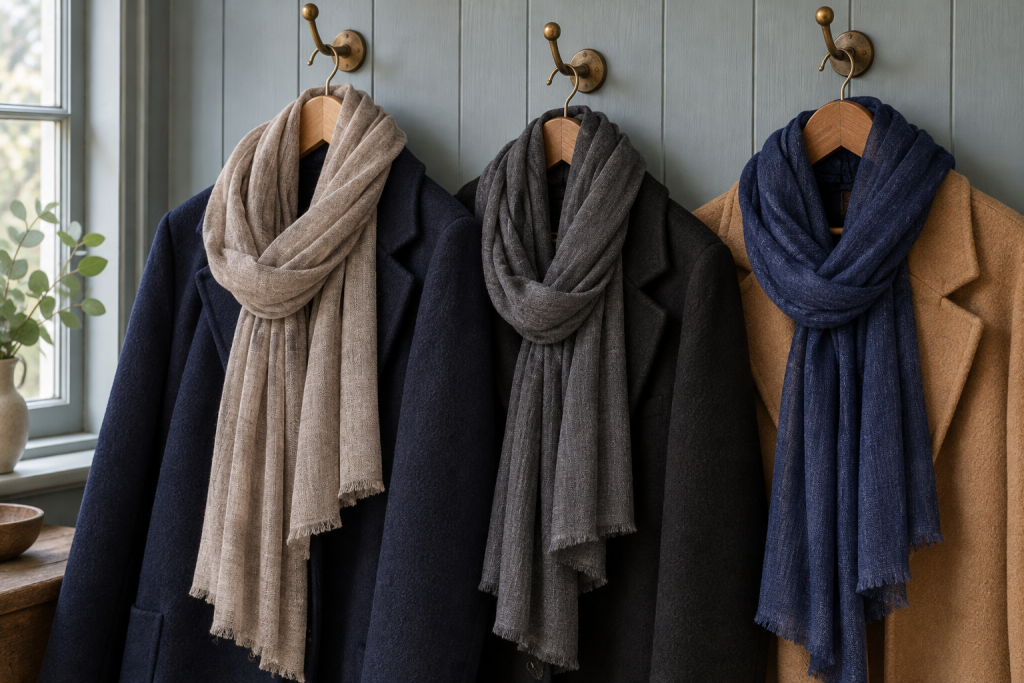
Deciding what colour scarf to wear is easier when you begin with your coat rather than a list of rules. Navy, black and camel each give a different background. A pale scarf brings light towards the face, a deeper shade keeps the contrast gentle, and a stronger colour can become the main detail in the outfit.
There is no single correct pairing. Think about whether you want the scarf to blend, stand out or connect colours you are already wearing. Then look at the combination in daylight, with the scarf folded as you would actually wear it.
Quick answer: Try cream, grey, soft pink or burgundy with navy; pale neutrals or a clear accent with black; and ivory, navy, dark brown or muted green with camel. These are starting points, not restrictions. The scarf’s texture, size and position near your face change the effect too.
What Colour Scarf Works With Each Coat?
| Coat | For a quieter look | For more contrast |
|---|---|---|
| Navy | Charcoal, medium grey, deep blue | Ivory, soft pink, burgundy |
| Black | Graphite, dark grey, black with a different texture | Cream, pale blue, a rich green or red |
| Camel | Ivory, oatmeal, dark brown | Navy, muted green, burgundy |
This table describes possible pairings, not a list of current Ochre stock. Compare the photographs and colour options on the specific product before choosing.
Choosing a Scarf With a Navy Coat
Navy is an easy base for both pale and dark scarves. Ivory gives a clear separation at the collar, while grey makes a softer transition. If your wardrobe already contains burgundy or soft pink, either can bring that colour into a winter outfit without changing the coat.
For a simple weekday combination, try navy outerwear with grey trousers and a pale scarf. The scarf becomes the lightest part of the outfit. For something less contrasting, choose charcoal and let the difference in texture do more of the work.
Blue with blue can work too. Make the choice look deliberate: compare the shades together instead of expecting two separately purchased navies to match exactly. A noticeably lighter or more textured scarf often makes the pairing easier to read.
Choosing a Scarf With a Black Coat
A black coat gives you a strong background. A cream or pale-grey scarf makes the neckline more visible, while a deeper graphite keeps the overall outfit darker. Neither is automatically more flattering; try both near your face and decide which you enjoy.
If you want colour, start with one accent rather than trying to match every accessory. A green scarf with black boots and a black bag is already a complete choice. You do not need a second green item to justify it.
All black does not have to look flat. A plain black coat and a black knitted scarf can differ in surface, softness and drape. Look at the fabrics together rather than judging the combination only by their colour names.
Choosing a Scarf With a Camel Coat
Camel coats vary from pale beige to deeper golden brown. This makes comparison especially useful. An oatmeal scarf may sit very close to one coat and appear noticeably cooler against another.
Ivory offers a light, calm starting point. Dark brown gives depth within a similar family, while navy creates a clearer contrast. Muted green or burgundy can work when you want a richer accent without a very bright finish.
If everything feels too similar, change either the depth of the scarf colour or its texture. You do not need to abandon neutrals; a darker scarf may be enough to separate the layers.
Decide How Much Scarf You Want to See
The same colour can look restrained when tucked inside a coat and much bolder when spread across the shoulders. Test the amount of fabric as well as the shade. A wide piece in a bright colour has more visual presence than a narrow strip at the neck.
If the names are confusing, our guide to scarves, mufflers and wraps explains the practical differences. Measurements are more helpful than assuming that every accessory called a scarf has the same scale.
Ochre’s Fine Scarf is a lighter knitted option to fold or wear loosely at the neckline. For more coverage, the Cashmere Travel Wrap is a 200 × 90 cm piece in 100% cashmere. Its wider shape lets a colour become a larger part of the outfit, so compare the proportions as well as the shade.
Make the Choice in Daylight
- Put on the coat and the top you are likely to wear beneath it.
- Place the scarf near the face, rather than comparing the fabrics across a table.
- Fold or drape it as you would outdoors. Check whether the coat collar still sits comfortably.
- Look at the outfit from a little distance. Decide whether the scarf blends in or takes the attention you intended.
- Try it with another coat or jacket you own before deciding how useful it will be.
When buying online, compare the product’s own colour photographs. Screen settings and lighting can change the appearance, so a name such as stone or navy is not a precise colour specification. Ask Ochre for help with a particular shade if the difference matters to your outfit.
A Small Checklist for a Scarf You Will Use
- It works with the coat you wear most often.
- You like the colour beside your face in daylight.
- The width feels comfortable around your collar.
- The fabric is pleasant in the way you plan to wear it.
- You can picture a second outfit without buying matching accessories.
Frequently Asked Questions
Should my scarf match my coat?
It can, but it does not have to. A close match gives a quieter look, while a contrasting shade makes the scarf more visible. Texture can create interest even when both pieces are the same colour.
Does a scarf need to match my bag or shoes?
No. Keeping the rest of the accessories simple is often enough. Repeating one colour can be pleasing, but an exact matching set is a choice rather than a requirement.
Can I wear a patterned scarf with a plain coat?
Yes. A plain coat gives a pattern space to show. Start with a scarf containing a colour already present in your outfit if you want an easy connection between the pieces.
Which scarf colour is most versatile?
The one that works with your own outerwear and feels good near your face. Grey, ivory, navy and brown are useful starting points, but no single neutral suits every wardrobe.
Start with your favourite coat, then find the scarf that makes it feel different.
Explore Ochre scarves and wraps

